
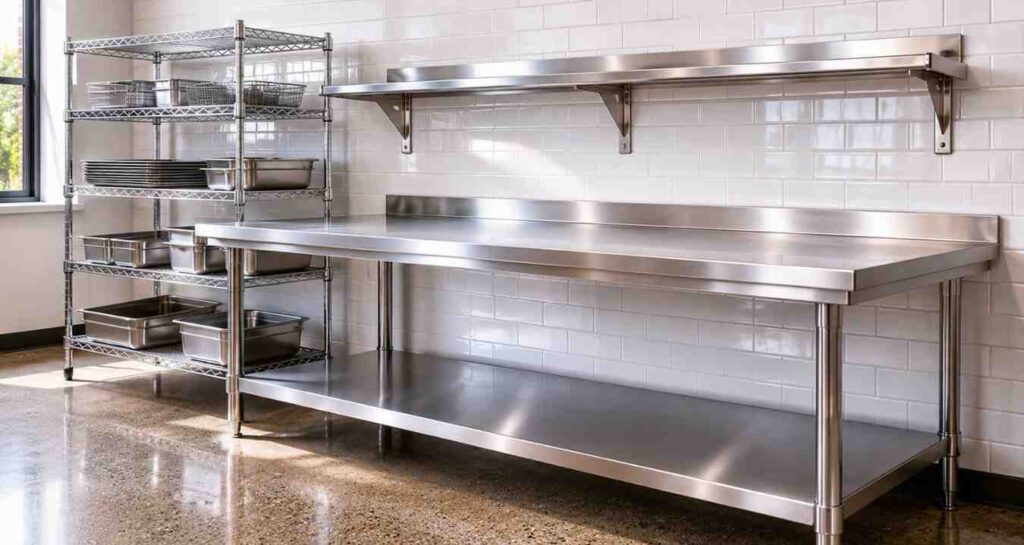
Most kitchens buy a work table, a wall shelf, and a storage rack one at a time – then discover during setup that the heights don’t match, the depths interfere, or the rack sits where someone needs to stand. The three pieces are one prep station.
Plan them that way, and the station works. Buy them in sequence, and you spend the next month working around the gaps. This post covers how to choose each piece and how to size them so they fit together the first time. Everything covered here is available at Express KitchQuip, shipped online directly to your door.
What are the three things you should plan together?
The three are the work table, the wall-mounted shelf above it, and the rack or undershelf that handles bulk and overflow.
Here is what each one does:
- The table is your work surface. It is where cutting, portioning, plating, and most manual prep happen.
- The wall shelf is your reach storage. Containers, squeeze bottles, spice blends, and anything that needs to be in arm’s reach without sitting on the table.
- The rack handles bulk and overflow. Sheet pans, hotel pans, dry goods, and anything that does not belong in the reach zone but needs to be close.
Buying them at different times causes problems because each piece has its own height, depth, and clearance spec. Get one wrong, and the others are already ordered.
Why plan a work table, shelves, and racks as one prep station?
Because they share the same space, the same reach zone, and the same workflow. A choice on one changes what works for the others.
The work surface sits at a standard 36 inches. The wall shelf hangs in the reach zone directly above it. The rack lives below, beside, or behind. These three pieces define the same physical column of space, from the floor to about 84 inches. If the table depth is 30 inches and the wall shelf is only 12 inches deep, items fall into the gap. If the rack is 74 inches tall and sits at the end of the table, it blocks the light and the path.
Get the spacing wrong, and staff spend the whole shift bending, twisting, and crossing paths. That adds up across a service.
The shared constraints are:
- Surface height – 36 inches is the NSF/ANSI standard, and what most cooks are sized for
- Reach zone – the 20 to 24 inches above the table surface, where everything in active use should live
- Work-aisle width – the corridor around the station, which sets how wide the table and rack can be
Plan these three numbers first. Then select the pieces.
How do you choose steel tables for a commercial kitchen?
Match the gauge to the job and the grade to the moisture. Those are the two decisions, and they are not interchangeable.
Browse Work Tables at Express KitchQuip, and you will see tables listed by gauge and grade. Here is how to read those specs.
What gauge do you need?
Gauge is a counterintuitive number: the lower the gauge, the thicker the steel.
- 18-gauge – light prep, budget operations, lower-volume kitchens
- 16-gauge – the everyday choice for busy restaurants; it handles most prep work without denting under a mixer or a hotel pan
- 14-gauge – heavy-duty work, butchering stations, anywhere steel takes direct impact
For most operations, 16-gauge is the right call. It costs more than 18-gauge and less than 14-gauge, and it holds up in real kitchen conditions.
304 or 430 stainless?
The grade matters more in wet zones than dry ones.
| Grade | Best for | Watch out for |
| 304 | Food-contact prep surfaces, wet zones | Costs more than 430 |
| 430 | Undershelves, dry zones, side panels | Surface rust, if kept wet long-term |
| 316 | Coastal or salt-air kitchens | Premium price; most kitchens do not need it |
If you run a kitchen near salt air – waterfront restaurants, coastal hotel kitchens – 316 is worth the premium. The passive layer in 304 and 430 breaks down faster in that environment. Everywhere else, 304 for the work surface and 430 for the undershelf is the standard choice.
How much weight can commercial wall-mounted kitchen shelves hold?
The number on the spec sheet assumes the shelf is bolted into studs or masonry. The wall behind it is the real limit, not the bracket.
Browse Wall Shelves and Double Over-Shelves for commercial wall-mounted kitchen shelves in stainless steel, sized from 18 to 72 inches wide.
The load rating works like this:
- Into wall studs or masonry: close to the rated capacity on the spec sheet
- Into bare drywall with toggle anchors: a fraction of that – a shelf rated for 50 lbs can drop to around 12 lbs of real usable load
- Rule of thumb: a shelf is only as strong as the wall behind it
Quick install checklist
Follow these steps before hanging anything:
- Find the studs or confirm masonry behind the surface.
- Match the anchor type to the wall – toggle bolts for drywall, lag screws for studs, masonry anchors for concrete block.
- Use 2 brackets up to 60 inches of shelf length, 3 brackets at 72 inches and beyond.
- Keep any dry-storage shelf at least 6 inches off the floor for health inspection compliance.
Skipping step one is the most common installation mistake. The shelf looks fine until weight is put on it.
When do you need custom stainless steel racks for kitchens?
When the space is irregular, or a stock size will not fit, custom is worth the cost. When a standard size fits, it does not.
Browse Storage Racks and Equipment Stands – most stations use stock sizes without any issue.
Go custom when:
- The footprint is odd, or you are building around fixed equipment that cannot move
- You need a seamless welded surface for easier sanitation (fewer seams means fewer places for debris to collect)
- Standard sizes leave dead space that kills workflow
Stick with the stock when:
- A standard size fits the wall or floor run
- You need it faster and cheaper – stock ships faster, costs less, and is easier to replace
Welded or bolted?
Welded racks are stronger and more sanitary. Fewer seams means fewer debris traps and faster cleaning. Bolted knock-down racks cost less, ship flat, and are easier to move or reconfigure. For a fixed prep station in a permanent location, welded. For a catering setup or a kitchen that rearranges seasonally, knock-down.
How do you size all three to fit your space?
Plan the aisle and the reach zone first. Then select pieces that fit inside those numbers.
When you map steel tables for commercial restaurants against your aisle width, the sizing falls into place quickly. Here are the working numbers:
- Work aisle: roughly 42 inches for one cook, 48 inches for two working the same station
- Work surface: about 4 feet of table per cook; two shorter tables often work better than one long one because they create a natural break in the workflow
- First wall shelf height: 20 to 24 inches above the table surface puts it in reach without forcing an upward stretch
- Table depth: 24 inches is standard; step up to 30 inches if you run full sheet pans flat on the surface
One note: Confirm local health code with your health department before the station is finalized. Some jurisdictions have minimum clearance requirements that affect shelf height and aisle width.
Where can you buy these online, and do they meet code?
Yes. The full prep station – table, wall shelf, and rack – can be ordered online and shipped to your door. Buy NSF-certified pieces, and they will pass a health inspection.
NSF certification is the mark a health inspector looks for. It means the piece was tested for materials, construction, and cleanability – specifically, whether it can be sanitized without trapping residue. Every product Express KitchQuip carries meets or exceeds NSF/ANSI 2 standards for food equipment.
Whether you are shopping for restaurant kitchen equipment online in Miami or ordering from a kitchen in the Midwest, the catalog is the same, and the specs do not change by location. The same 16-gauge 304 table ships to a hotel kitchen in Chicago and a deli counter in South Florida.
The same prep-station logic applies behind the bar. If you are looking to get portable bar equipment and buy online in New Jersey, the sizing principles carry over – surface height, reach zone, and aisle width work the same whether the station is in a kitchen or behind a cocktail bar. Browse Bar Equipment for bar-specific sinks, ice bins, and workstations built to the same specs.
Express KitchQuip ships from its Florida warehouse (Boynton Beach, FL) with free shipping on all orders. Use code WELCOME5 at checkout for 5% off your first order.
[Great company to work with! I got a fantastic price on the equipment I purchased, and everything was handled smoothly and professionally. The entire process was easy and stress-free…highly recommend! – Raquel Rosenthal]
Plan them together. Order them in one place.
Pick the table gauge and grade first, then size the wall shelf to hang in the reach zone above it, then choose the rack or undershelf that fills what is left. Done in that order, all three fit. Done separately, someone is moving furniture after delivery.
Whether you are setting up a restaurant kitchen equipment station in Miami or sourcing portable bar equipment online in New Jersey, the catalog covers the full station. Free shipping on every order, NSF-certified pieces throughout, and WELCOME5 for 5% off when you are ready to buy.
Shop Work Tables, Wall Shelves, and Storage Racks at Express KitchQuip
Frequently Asked Questions
Is 430 stainless steel food safe?
Yes. 430 is acceptable for food contact and is widely used for undershelves and side panels. It is less corrosion-resistant than 304, so keep it away from constantly wet or salty environments where surface rust becomes a cleaning and inspection problem.
Can you put a mixer or heavy equipment on a stainless work table?
Yes, if the table is rated for it. Check the top’s load rating before setting anything heavy down. A 16-gauge table handles more than an 18-gauge one, and very heavy equipment – floor mixers, slicers – is better placed on a dedicated equipment stand sized for the load.
Do wall shelves need to go into studs?
For real working weight, yes. Capacity drops sharply when a shelf is anchored into bare drywall instead of studs or masonry. Always identify what is behind the wall before ordering the hardware, and match the anchor type to the substrate.
How far apart should wall-shelf brackets be?
Use two brackets for shelves up to 60 inches long and three brackets at 72 inches and beyond. Spacing beyond that allows the shelf to bow under load, which is a safety and inspection issue.
What height should a commercial prep table be?
The NSF/ANSI standard is 36 inches, which is the comfortable working height for most kitchen staff and lines up with the reach zone for the wall shelf above it. Adjustable-leg tables let you shift a few inches in either direction if your staff runs tall or short.