
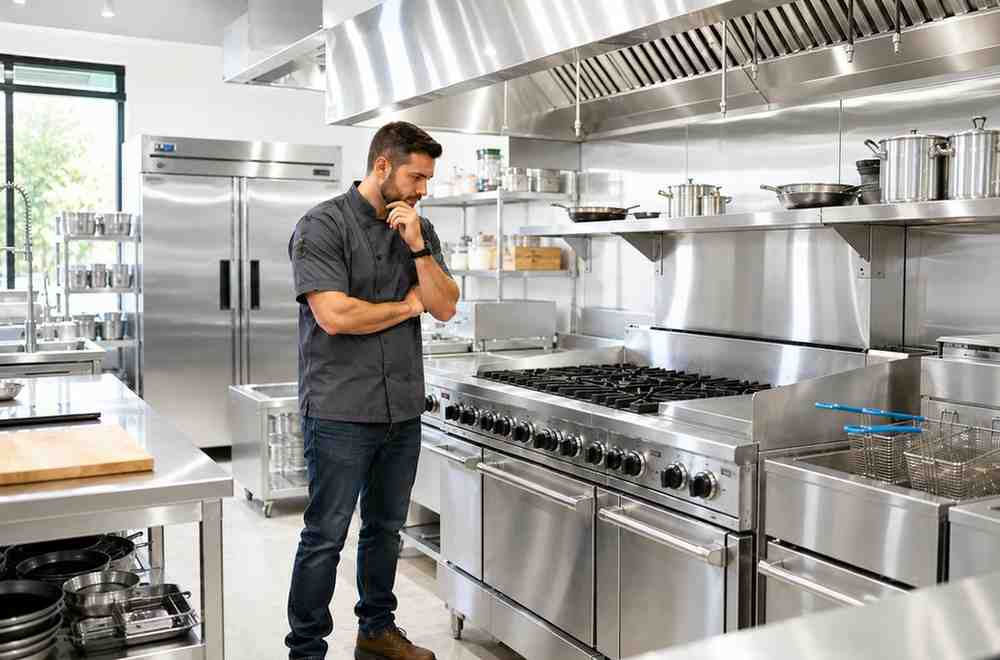
Opening a restaurant is expensive, but buying the wrong kitchen equipment can be one of the costliest mistakes you’ll make. A range that’s too small, the wrong fuel type, or a poorly planned kitchen layout can slow service, frustrate staff, and lead to expensive upgrades sooner than expected.
Before you invest, here are seven common equipment mistakes that can cost new restaurant owners time and money and how to avoid them.
It’s tempting to start shopping as soon as you’ve signed a lease, but your menu should always come first.
Think about it this way. A breakfast café, a steakhouse, and a ramen restaurant may all need cooking equipment, yet the equipment each business depends on is completely different. Buying first and planning later often results in equipment that doesn’t match your day-to-day operations.
For example:
The more your equipment reflects your menu, the smoother your kitchen will run.
Imagine your restaurant becomes the neighborhood’s new favorite. Friday evenings are fully booked. Online orders continue to grow. Weekend lunch service is busier than expected.
Now picture trying to manage that demand with equipment selected only for your first week in business.
Many restaurant owners underestimate how quickly cooking capacity becomes a limitation. Adding equipment after opening usually costs more and can interrupt daily operations.
When choosing commercial kitchen equipment, think beyond today’s business.
Ask yourself:
Planning for growth today is usually less expensive than replacing equipment later.
Oversized equipment can reduce workspace, create crowded aisles, increase utility costs, and make daily operations less efficient. Instead of asking, “What’s the biggest range I can fit?” Ask, “What’s the right size for the way my kitchen actually cooks?”
Here’s a simple comparison.
| Instead of… | Consider… |
| Choosing the largest model available | Choosing equipment that matches your menu and production volume |
| Filling every available space | Leaving room for safe movement and efficient workflow |
| Buying for occasional busy days | Buying for consistent daily service with room to grow |
A kitchen that flows efficiently almost always performs better than one filled with oversized equipment.
Now suppose your cook prepares burger patties on one side of the kitchen. The prep station sits at the opposite end. Buns are stored near the assembly counter, while the fryer is located behind another workstation.
Nothing is technically wrong. But every order requires unnecessary walking.
Multiply those extra steps by hundreds of tickets every day, and suddenly service becomes slower. Not because your team lacks experience, but because the kitchen wasn’t designed around efficient movement.
Before selecting equipment, think about how your staff will move during a busy shift. Workstations, stainless steel prep tables, and properly placed commercial kitchen sinks in California all contribute to a smoother workflow.
Quick Tip: Sketch your kitchen layout before purchasing equipment. Visualizing prep, cooking, plating, and cleaning stations can help you spot workflow issues before installation.
Every new restaurant has a budget. But choosing equipment based only on the lowest price can become expensive over time.
Commercial kitchens operate for hours every day. Equipment that struggles under constant use may require more maintenance, create downtime, or need replacement sooner than expected.
Instead of asking, “What’s the cheapest option?” Consider asking:
A well-built piece of equipment often delivers better value over its lifespan than a cheaper alternative that needs frequent repairs.
Finding the right equipment is only part of the process. Before placing an order, make sure your kitchen is actually prepared to support it.
Questions worth checking include:
These details are easy to overlook during the excitement of opening a restaurant, yet they can delay installation and increase project costs if discovered too late.
A quick conversation with your contractor or installer before purchasing equipment can prevent unexpected surprises.
One of the most common misconceptions is that a new restaurant needs every possible piece of equipment before opening. But you can begin with the essentials and expand as customer demand grows.
Start with the equipment your menu depends on every day. As your business evolves, you can add specialized cooking equipment, additional storage, and heavy-duty stainless steel shelving to support growing inventory and improve organization.
Taking this phased approach often helps you:
Buying smarter is often more valuable than buying more.
If you’re preparing to purchase commercial kitchen equipment, take a few minutes to review these questions:
✓ Does this equipment support my menu?
✓ Is it the right size for my available space?
✓ Can it handle peak-hour demand?
✓ Does it match my fuel and utility setup?
✓ Will it still meet my needs a year from now?
If you answered “no” to any of these, it’s worth revisiting your equipment plan before making a significant investment.
Avoid costly equipment mistakes by choosing commercial cooking equipment designed for your menu, workflow, and future growth. Explore our commercial kitchen equipment for sale in California and find reliable solutions for your restaurant.
Start with the equipment your menu relies on every day, such as cooking equipment, refrigeration, food preparation stations, and storage. Specialty equipment can often be added later as your business grows.
Consider your menu, available kitchen space, expected customer volume, fuel source, and long-term business goals before making a purchase.
Not always. Many restaurants begin with essential equipment and expand their kitchen as demand increases and the menu evolves.
The right choice depends on your cooking style, available utilities, and operational preferences. Both options have advantages depending on your kitchen’s needs.
If you’re looking to buy commercial kitchen equipment, Express KitchQuip offers a wide selection of cooking, prep, storage, and refrigeration equipment with convenient online ordering and reliable shipping across the state.